


Is coding still worth learning in 2026?
What AI changed about the job, what the junior market really looks like, and how to learn in a way that still gets you hired.

Table of contents
One of the most common questions I see in our community right now is whether it's still worth learning to code in 2026. It's a fair question, with AI writing more of the code and plenty of people saying the path is closing. It deserves more than a one-word answer, so I want to walk through what's changed: what the job looks like now, what the job market really looks like for new developers, and how to learn in a way that still gets you hired.
I'll say up front that I'm biased. I'm a developer, I run a company that helps people get into the industry, and our team builds software ourselves. But I've spent years watching how people learn to code and what happens when they try to break in, and I'll back up what I say as we go. My view is that it's still worth it, as much as it ever was, maybe more. What's changed is what you should focus on while you learn.
What AI changed
AI is good at producing code now, and not just boilerplate. It'll write a whole feature from a prompt, or refactor across a dozen files, and a lot of the time, what comes back works.
What it still struggles with is everything around that code: knowing what to build in the first place, reading what it produced and telling whether it's right, spotting where it'll fall over in production, and deciding how the pieces fit together. That's the part that was always hard. There's now far more code moving through every project, so having someone who can stand behind it all matters more than it used to.
So what matters is where you spend your time while you learn.
AI writes a lot of the code now
So, how much code is AI writing? More than most people expect, and the number climbed fast over the past year.
At Google, Sundar Pichai said in April 2026 that 75% of all new code is now AI-generated and approved by engineers, up from 50% the previous fall. Anthropic, the company behind Claude, puts its own figure north of 90%. These are the firms furthest down this road, so read their numbers as the leading edge rather than the average. The direction is clear enough either way.
Two details matter here. First, that phrase from Google: approved by engineers. The code is generated by an LLM, then a person reads it, decides whether it's right, and takes responsibility for it. Second, what developers say about trusting it. In Stack Overflow's 2025 survey of nearly 50,000 developers, 84% use or plan to use AI tools, and about half reach for them every day. Just 3.1% said they highly trust the accuracy of the results. People are constantly leaning on these tools and checking their work just as constantly, which tells you where the real skill now lies.
And more AI hasn't lightened the load, which surprises people. Most developers and founders I know are busier than ever. It speeds up parts of the work, but the work is still there, and it still needs someone who knows what they're doing. Building software was hard before any of this, and it's still hard. Better tools haven't changed that.
The job moved up a level
If a machine writes most of the code, the human job moves up a level. You spend less time typing and more time deciding: what to build, how it should work, and whether what comes back is any good. That's a harder skill than typing, and a much rarer one.
You'll increasingly see the term "product engineer" for someone who takes a problem and owns it end-to-end, from working out what's worth building through to shipping something that solves it. Companies like Vercel and Intercom have started hiring for the title directly. As Atlassian described it, the gap between "I know what we should build" and "here's a working prototype" has compressed from weeks to hours, so the hard part becomes knowing what's worth building in the first place.
One word keeps coming up for this: taste. Paul Graham put it plainly: when anyone can make anything, the big differentiator is what you choose to make. Greg Brockman, OpenAI's president, called taste a new core skill. Whatever you call it, the shift is real. When code is cheap to produce, the valuable skill is telling whether it's any good.
None of this means you can skip the code, though. You don't build judgment by skipping the work itself. Whether you typed a line or an AI did, you're the one responsible for it, and you can only tell good from bad once you've written enough of both to know the difference. Taste in software comes from having built things, broken them, worked out why, and built the next one better. You can't shortcut your way to it.
So the fundamentals matter more now than they used to, at least if you want to do this for a living. If you just want to vibe-code a quick app to test an idea, you can lean on AI and skip most of what's here. But to get hired or to build something real enough for other people to rely on it, you need them. Don't skip them. They're what everything else stands on.
I see what skipping them looks like. People come into our community and go straight for the intermediate and advanced projects, leaning hard on AI to push through. You can tell from the questions they ask or the code they end up with that they haven't taken in what those projects were meant to teach. They're trying to fast-track their way to becoming a developer, which is completely natural to want. I get the urge. But there are no shortcuts to building software well, and the people who look for them usually end up stuck.
The junior job market, realistically
Now the part that's harder, and I want to be straight with you about it.
The overall field is growing. The US Bureau of Labor Statistics projects that jobs for software developers will grow 15% between 2024 and 2034, about five times the average across all occupations, and names AI as one of the drivers. So "software is a dead career" doesn't hold up.
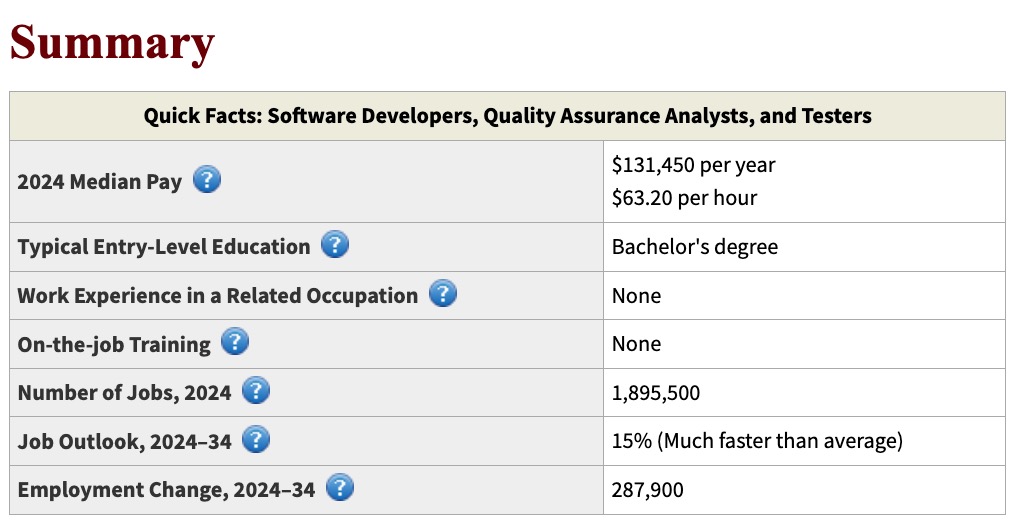
US Bureau of Labor Statistics summary for Software Developers, QA Analysts, and Testers
The entry level, though, got tighter. Companies are posting junior roles and often filling them with people who already have a few years of experience. At the big tech firms, new grads were just 7% of recent hires, down about a quarter from 2023, while hiring of people with 2 to 5 years of experience increased. "Entry-level" increasingly means "two years in," and front-end junior demand specifically fell by more than a fifth over the past year.
The cause matters because the popular story (AI took the jobs) is only part of it, and probably the smaller part. Most of the slowdown traces back to the hiring correction after the cheap-money boom of 2020 to 2022. Nearly half the drop in tech job postings happened before ChatGPT was even released. A US tax change made hiring engineers more expensive around the same time. AI is starting to affect entry-level work too, but the most-cited study on that comes with heavy caveats from its own authors; another study found no measurable effect, and most employers say they're using AI to support their juniors rather than replace them. So the door is harder to get through than it was in 2021, mostly because of the market, with AI as a factor that's still taking shape.
There's a second thing making the market look scarier than it is. Applying has turned into a numbers war. AI lets people fire off applications by the hundred, and one job seeker was documented sending more than 2,800. Applications on LinkedIn jumped by about 45% over a year, to roughly 9,500 per minute, while the number of jobs fell. You end up with AI writing the applications and AI screening them, which is as broken as it sounds. So a single opening can show hundreds or thousands of applicants.
Don't take that number at face value, though. A large share of those people barely read the job description, and they get filtered out quickly, often by software before a human even sees it. So ask yourself, over and over: why would this company pick me over everyone else who applied? If you've got solid foundations, you've built genuinely complex projects to a high standard, and you can talk about them in depth, then the real competition is much smaller than the headline suggests. A thousand applicants become a hundred. A hundred becomes ten.
That should change how you apply. It's fine to apply widely and quickly to roles you're lukewarm about, but for the ones you actually want, slow down, make it personal, and don't hand the application to AI. In a stack of near-identical AI-written applications, a real one stands out. There's more tactical detail than I can fit here in my guide to getting a programming job in 2026.
The pattern I keep seeing
After watching many people go through this, the strongest predictor of who makes it is almost embarrassingly obvious. It's whether they keep going.
We sometimes get people coming into our community looking for a fast track to a well-paid job, and some have said so outright. I understand the appeal, because for a while, that's how it worked. Through the 2010s and the hiring boom, you could finish a bootcamp and walk into a role. I did exactly that myself. But that era has unfortunately passed, and what's left rewards the people who genuinely enjoy building things.
We see it happen on the platform. People get stuck on their first project, and many give up or retreat to tutorials they can code along with. The ones who stick around work their way up through the levels, ship frontend and full-stack projects to a high standard, and build a real body of work. That second group has a much easier time getting a foot in the door. It nearly always comes down to sticking with it and genuinely enjoying the process of building.
I became a developer through a bootcamp myself. In 2014, I did a three-month course at General Assembly and got hired eight days after it finished. Bootcamps still exist, and I still rate them, though the quality varies a lot and they're a bigger gamble now that the market is tighter. The better news is that there are far more routes in than there were back then. You can learn online through project-based practice, which is most of what we do at Frontend Mentor, though we're far from the only option. And used well, AI can help you learn faster while you get fluent with the tools you'll use on the job.
How to build the skills that get you hired
The bar for getting in has gone up. Companies expect more from a junior than they did five years ago, including the ability to work well with AI tools. That part is good news, because it's part of your edge.
The junior that a hiring manager wants in 2026 has solid foundations, a lot of real projects built (including some hard ones), and the ability to reason about the decisions behind them. On top of that, they're fluent with AI tools and the workflows around them. That combination is an unusually good hire: someone who's useful from the start and still has room to grow into a team. Take away the foundations, though, and the AI fluency counts for little.
How you use AI while you're still learning matters a lot here. I use it constantly in my own work, so this isn't an anti-AI take. But as a learner, don't let it do your thinking, and don't have it write code you haven't written yourself many times over. Use it to ask questions, to help you debug, and to poke holes in code you've already written. Anthropic ran a study in which developers who leaned on AI scored nearly two letter grades lower on a comprehension test than those who worked by hand, with the widest gap in debugging. Skip the friction, and you skip the learning, because the friction is where the learning happens. We've written more about this in our guide to using AI as a beginner, and it's built into the challenges themselves: our starter code ships with rules that make the AI behave like a patient mentor on beginner challenges and a tougher collaborator as you level up.
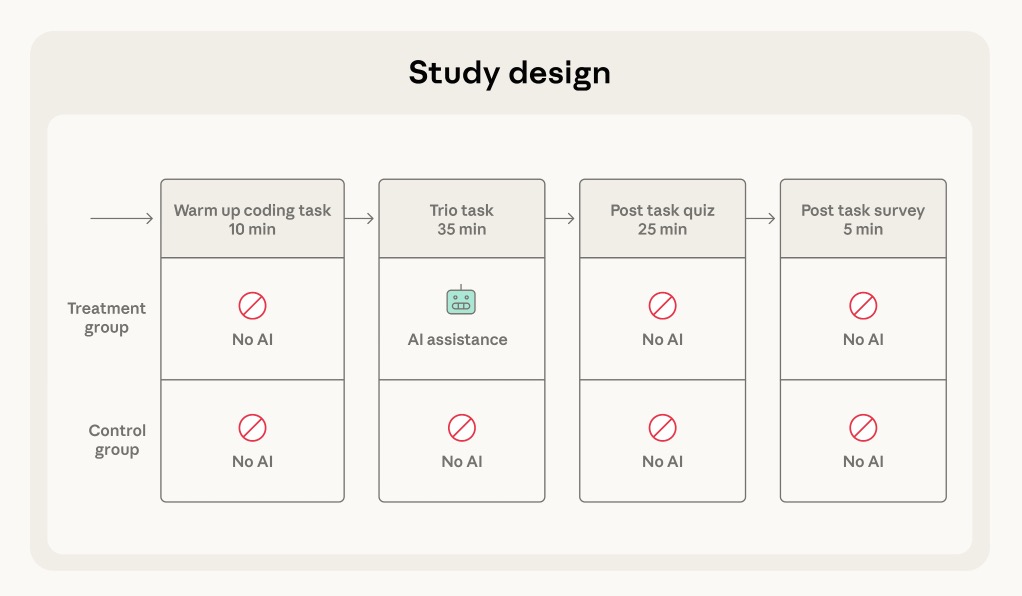
Anthropic’s study design
There's another edge that's easy to overlook, and it's especially relevant if you're switching careers. Because AI handles more of the implementation now, what you know about a specific industry is worth more than it used to be. Say you're a nurse moving into software. A few years ago, your medical background was a nice extra, and as a junior, you'd mostly be handed tickets to build. Now that the raw implementation is partly handled for you, your grasp of how a hospital actually works could become a real advantage in certain health tech companies or startups. The same is true across many fields that were never software-heavy, because building software has become cheap enough that many more of them will likely start doing so. Whatever you did before can become a real head start.
All of this points to the same way of practicing, and there are two modes worth running. One is hand-typing projects from scratch, which builds the muscle memory and the mental models so you understand the tools you're using. The other is the AI-assisted workflow you'll often use professionally, where you direct the tools and review what they produce. An LLM writing your code doesn't make the code good. You're still the one accountable for it, so you have to understand it, and that understanding only comes from hours of writing code, reading code, and reading other people's code, including the code an AI hands you.
This is most of what we do at Frontend Mentor. The design-led challenges build that foundation. Submit a solution, and you get an AI code review across the dimensions that matter, from accessibility to architecture, plus feedback from other developers, so you start to see what good looks like. Our product challenges take on the other half directly: they're spec-driven, you're encouraged to work with AI to reach the outcome, and they exercise the skills the job now turns on, working out what to build and collaborating with AI to build it well. It's the product-engineer skill set from earlier, turned into something you can practice.
So, is it worth it?
Yes, with your eyes open. The work shifted toward judgment, taste, and knowing what to build, and you get there the way people always have, by building real things and learning from what breaks. AI helps with that if you use it to sharpen your understanding rather than skip it. So pick one project, a level beyond what feels comfortable, and build it properly. Then build the next one. Give it a go and let me know how you get on.
Questions I hear a lot
Will AI replace software engineers? Not in the way the headlines suggest. It's automating a lot of the typing, but someone still has to decide what to build, judge whether the result is any good, and stand behind it. At companies that use AI the most, the code is still approved by engineers, and most developers don't fully trust what it produces. The job is changing rather than disappearing.
Is coding a good career in 2026? Yes. The US Bureau of Labor Statistics projects software development jobs to grow 15% through 2034, well above the average for all occupations. The catch is the entry level, which is tougher than it used to be, so the way in is to show up with real, demonstrated skill.
Is it too late to learn to code? No. The bar moved toward judgment and building real things, and both are learnable. It takes longer than the old bootcamp-to-job timelines, but the path is open.
Should beginners use AI to learn? Yes, carefully. Use it to ask questions, explain ideas, and help you debug. Don't let it write code you haven't learned to write yourself. The understanding is the whole point, and offloading it to AI defeats that.
Is AI really writing 90% of code? At the frontier AI labs, the share is genuinely high. Google says 75% of its new code is AI-generated and approved by engineers, and Anthropic puts its own figure above 90%. For most teams, it's a lot lower; the numbers are measured loosely, and a human reviews the output. Treat the scariest headline figures with care.
What should I build to get hired? Real, finished projects you've deployed and can talk about in depth, ideally a few that are genuinely complex. A hiring manager can tell the difference between a project you understood and a tutorial you followed. Decisions you can explain beat polish you can't.
Take your skills to the next level
- AI-powered solution reviews
- 50+ portfolio-ready premium projects
- Professional Figma design files